clinical
Dentistry’s Next Divide: Data-Rich Care, Training-Poor Systems
Smart floss, salivary metrics, and maternal-immune links are pushing dentistry into measurable medicine—while cybersecurity outages and uneven continuing education expose fragile implementation capacity.
By Dr. Sarah Chen ·
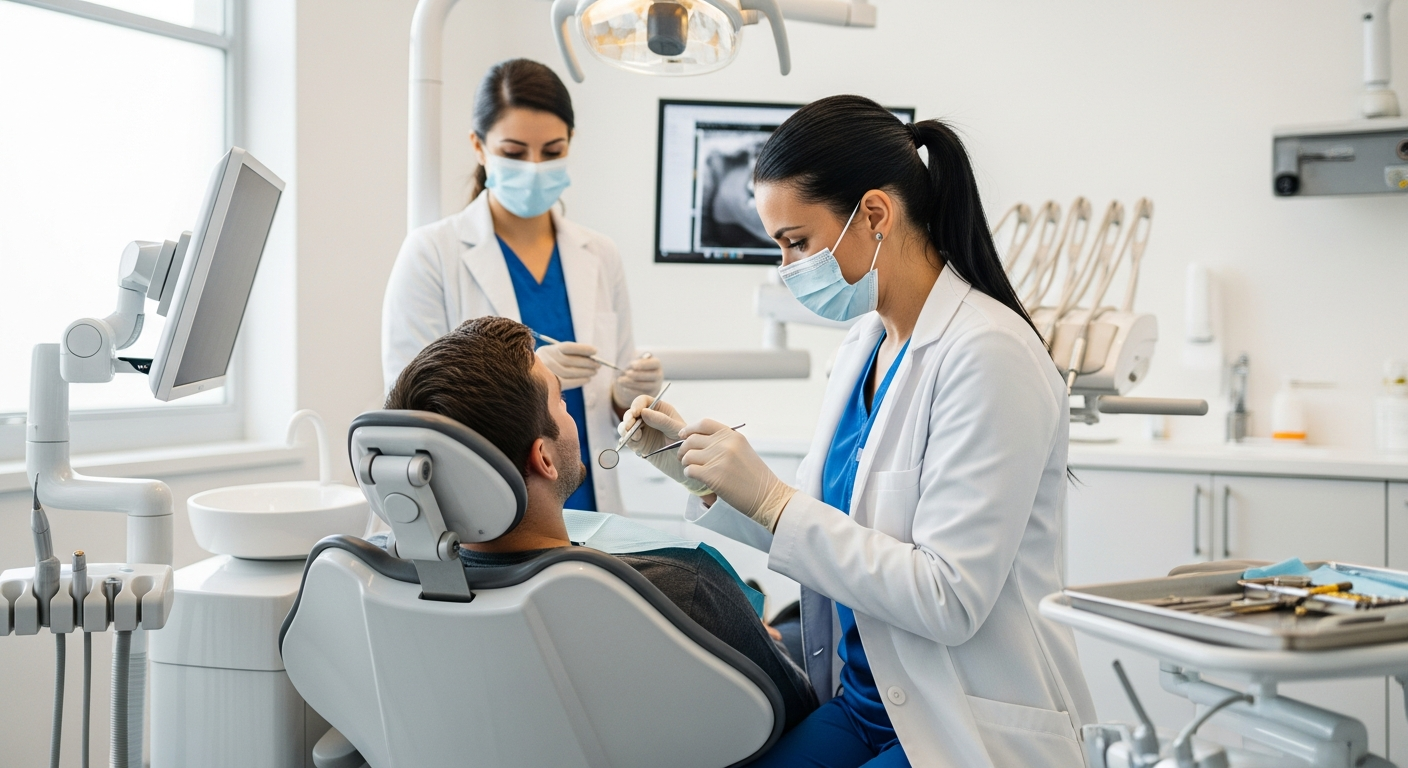
The most revealing dental “innovation” story this month wasn’t a new composite or a faster scanner. It was a day when a dental organisation reportedly closed multiple locations because its network was down. In a sector that still prides itself on being hands-on and analog at the chairside, a routable packet became a single point of failure for clinical access. That is the non-obvious connective tissue across this news cycle: dentistry is rapidly becoming a data enterprise—clinical, behavioural, operational—and the industry is far less prepared to manage data integrity, clinician behaviour change, and patient trust than it is to buy the next device.
Consider the juxtaposition. On one side, researchers are turning interdental plaque into a diagnostic substrate. The “smart floss” and real-time monitoring flossing device stories describe a biosensing platform that uses gingival crevicular fluid and plaque-associated biomarkers to infer metabolic states—an ambition that explicitly crosses the boundary from oral hygiene into systemic screening. Whether the first commercial applications land in glucose surrogates, inflammatory markers, or stress hormones, the direction is clear: oral care is being reframed as continuous monitoring, not episodic repair. On the other side, a network outage can shutter clinics, and a dentist allegedly using a drone to stalk someone becomes a reminder that the profession’s governance of technology is still oriented toward clinical safety, not digital ethics and surveillance. Dentistry is being pulled into a world where the primary clinical risk is no longer just iatrogenic damage, but data misuse, system downtime, and behavioural non-adoption.
This is where continuing education (CE) stops being a box-ticking annoyance and becomes the industry’s throttle. The question “can continuing education actually change how dentists practice?” is less academic than it sounds. Implementation science in healthcare repeatedly shows that knowledge transfer is not the same as behaviour change; passive education alone tends to produce modest effect sizes, especially when incentives, workflows, and peer norms are unchanged. In dentistry, the gap is amplified by practice ownership structures. A dentist who owns the practice and controls scheduling, procurement, and staffing can implement change; an associate in a production-driven environment often cannot. If smart floss or salivary flow–based quality-of-life protocols require new consent language, new data handling, or extra chairside minutes, adoption will hinge on whether CE is coupled to practical tools: templated workflows, audit-and-feedback, calibrated case definitions, and reimbursement pathways. Without that, CE becomes a veneer—high attendance, low penetration.
The clinical science in these stories also carries a warning: dentistry’s next chapter will reward those who can quantify and stratify risk, but it will punish those who overpromise mechanistic certainty. Take the report that tooth loss may make you more prone to feel pain. The plausible biological pathways—central sensitisation, altered trigeminal input, psychosocial stressors, and inflammatory burden—align with what we know from chronic pain literature: persistent peripheral changes can reshape central processing. But the chairside implication is not that every edentulous patient is “destined” for pain. It is that oral rehabilitation planning should more deliberately integrate pain phenotyping, sleep, anxiety, and medication review, and that longitudinal outcomes matter as much as procedural endpoints. Similarly, work suggesting that salivary flow rate may moderate oral health–related quality of life impacts should change how we triage xerostomia: flow is not merely a symptom but a mediator that can shift functional and psychosocial burden. Yet the temptation—especially for companies selling sensors—is to equate more measurement with more truth. Measurement without clinical pathways simply creates a larger pile of unmanaged signals.
Now widen the lens to public health and policy, where measurement collides with structural reality. Reports on structural barriers and food insecurity constraining Indigenous Australian oral health choices are not “soft” social commentary; they are a reminder that caries risk is partially engineered by supply chains, pricing, and geography. You can prescribe high-fluoride toothpaste, but if households are choosing between food and fuel, prevention protocols become aspirational. That connects directly to the Israeli dental reform that significantly increased access for older adults. Reforms like these—when they include defined benefits, predictable funding, and outreach—change utilisation curves. They also alter the clinical mix that practices see: more medically complex older adults, more polypharmacy-associated dry mouth, and more demand for maintenance rather than heroic reconstruction. In that environment, the ability to integrate salivary diagnostics, risk-based recalls, and minimally invasive dentistry is not just clinically virtuous; it becomes operationally necessary to keep throughput and outcomes aligned.
The maternal oral health link to childhood allergic rhinitis and food allergy risk is a second frontier: dentistry’s reclassification from “mouth mechanics” to immunologic and developmental medicine. The mechanistic hypotheses—maternal microbiome shifts, inflammatory mediators, shared socioeconomic confounders, and antibiotic exposure—are not settled. But the direction of travel is unmistakable: obstetric, paediatric, and dental silos are being eroded by cohort data and systems biology. If associations persist after adjustment, the dental visit during pregnancy becomes less about emergency triage and more about preventive medicine with intergenerational stakes. That would demand a different standard of documentation, referral coordination, and patient messaging. It also raises liability and ethics questions: if we imply that treating gingivitis lowers allergy risk without robust causal evidence, we risk repeating earlier public-health overclaims. Precision in communication becomes part of clinical competence.
All of this returns to the unglamorous but decisive constraint: governance. The drone stalking allegation reads like an outlier—until you recognise it as the extreme end of a spectrum of technology misuse. Dentistry increasingly uses cameras, cloud-based imaging, AI triage tools, remote monitoring, and consumer-facing apps. Each expands the surface area for consent failures and boundary violations. Meanwhile, the network outage story underscores that downtime is no longer a billing inconvenience; it is a care-delivery event. If your practice management system, imaging archive, e-prescribing, or even door access is network-dependent, your cyber resilience is now a clinical quality metric. Industry insiders should stop treating cybersecurity and privacy training as “IT’s problem” and start treating it like infection control: standardised protocols, drills, vendor due diligence, and incident reporting pathways.
Here is the tension that ties these developments together: the industry is racing to capture more biologic data at the margin—plaque metabolites, salivary flow, microbiome proxies—while failing to solve the basic problem of reliable, ethical, implementable change at the core of practice. The dental sector loves technology that can be purchased, depreciated, and marketed. It is less comfortable investing in technology that cannot be photographed: staff training that changes habits, uptime architecture that prevents closures, consent processes that withstand scrutiny, and equitable delivery models that recognise food insecurity as a clinical variable. Yet those “invisible” investments are precisely what will determine whether biosensing floss becomes a meaningful medical adjunct or a novelty that generates noise and mistrust.
For manufacturers and investors, the commercial implication is that the next adoption barrier will be integration, not accuracy. A smart floss platform can demonstrate compelling sensitivity in a controlled setting, but real-world uptake will depend on interoperability with electronic health records, defensible data governance, and reimbursement logic. Who owns the data—the patient, the app, the dentist, the payer? Who is responsible for acting on an elevated signal? What is the standard of care if you receive longitudinal biomarkers suggesting worsening inflammation and do nothing? These questions are not footnotes; they are product requirements. For DSOs and large groups, resilience and standardisation become competitive differentiators. A network that can keep clinics open during an incident, preserve access to imaging, and maintain secure patient communication will outperform a competitor with a shinier marketing stack.
For clinicians, the “so what” is blunt. The profession’s credibility is moving from artisanal authority to measurable outcomes and trustworthy data stewardship. That does not mean dentists must become data scientists. It does mean that chairside excellence will increasingly include evidence-based implementation: selecting CE that includes audit tools and measurable endpoints; incorporating xerostomia flow assessment into treatment planning where appropriate; screening for pain sensitisation risk in edentulous or heavily restored patients; and communicating maternal-oral health evidence with calibrated language that respects uncertainty. It also means demanding better infrastructure from vendors and employers—because a practice that cannot function during a network disruption is not merely inefficient; it is clinically fragile.
Dentistry is on the verge of being judged by the standards applied to the rest of healthcare: continuity, equity, data ethics, and demonstrable impact. The industry can either treat that as an external imposition—or recognise it as an overdue maturation. The winners will not be the organisations that collect the most biomarkers, or the clinicians who accumulate the most CE credits. They will be those who can translate evidence into consistent practice, keep the doors open when systems fail, and earn patient trust in an era when oral data is becoming medical data.