technology
Dentistry’s Next Moat Isn’t Hardware—It’s Behavior Change at Scale
From Align’s iTero slowdown to AI toothbrushes and probiotics, the industry is pivoting from selling tools to proving outcomes amid labor scarcity and commoditized care.
By Dr. Sarah Chen ·
The most telling number in dentistry this year may not be a growth rate or a margin line; it’s the gap between what gets installed and what gets paid. Align Technology is reporting more iTero installations while scanner revenue softens—an inversion that would have been unthinkable when intraoral scanning was still a novelty and pricing power belonged to whoever shipped the box. In parallel, Philips is trying to “transform daily brushing habits” with an AI-enabled Sonicare, probiotics are being re-litigated as adjuncts to periodontal therapy, and the U.S. Health Resources and Services Administration is counting more than 8,000 dental shortage areas. Meanwhile, media outlets run seasonal warnings about Halloween candy cracking adult teeth, and clinics market “one-day digital implantology” to patients willing to cross borders for faster, cheaper care. Looked at separately, these are just headlines. Put together, they describe a non-obvious shift: dentistry’s economic center of gravity is moving from devices and discrete procedures toward behavior change that can be measured, monetized, and defended.
Align’s iTero story captures the tension. Installations rising while scanner revenue declines is not merely “pricing pressure”; it is a sign that the scanner is maturing into infrastructure—like a network router in enterprise IT. Once infrastructure, it is no longer the profit pool; it becomes the enabler of recurring revenue downstream: cloud software, case submissions, service contracts, and—most critically—clinical throughput. If ASPs are compressing via promotional pricing, bundles, or competitive encroachment, then the manufacturer is signaling that adoption matters more than upfront margin. That strategy only makes sense if the company believes the real annuity sits in utilization and data: more scans per chair per day, more aligner cases routed through proprietary workflows, and a tighter lock on the practice’s operating system. In other words, Align is not “selling scanners”; it is buying a larger share of the practice’s future behavior. The scanner becomes a distribution channel for protocol, not a product with intrinsic moat.
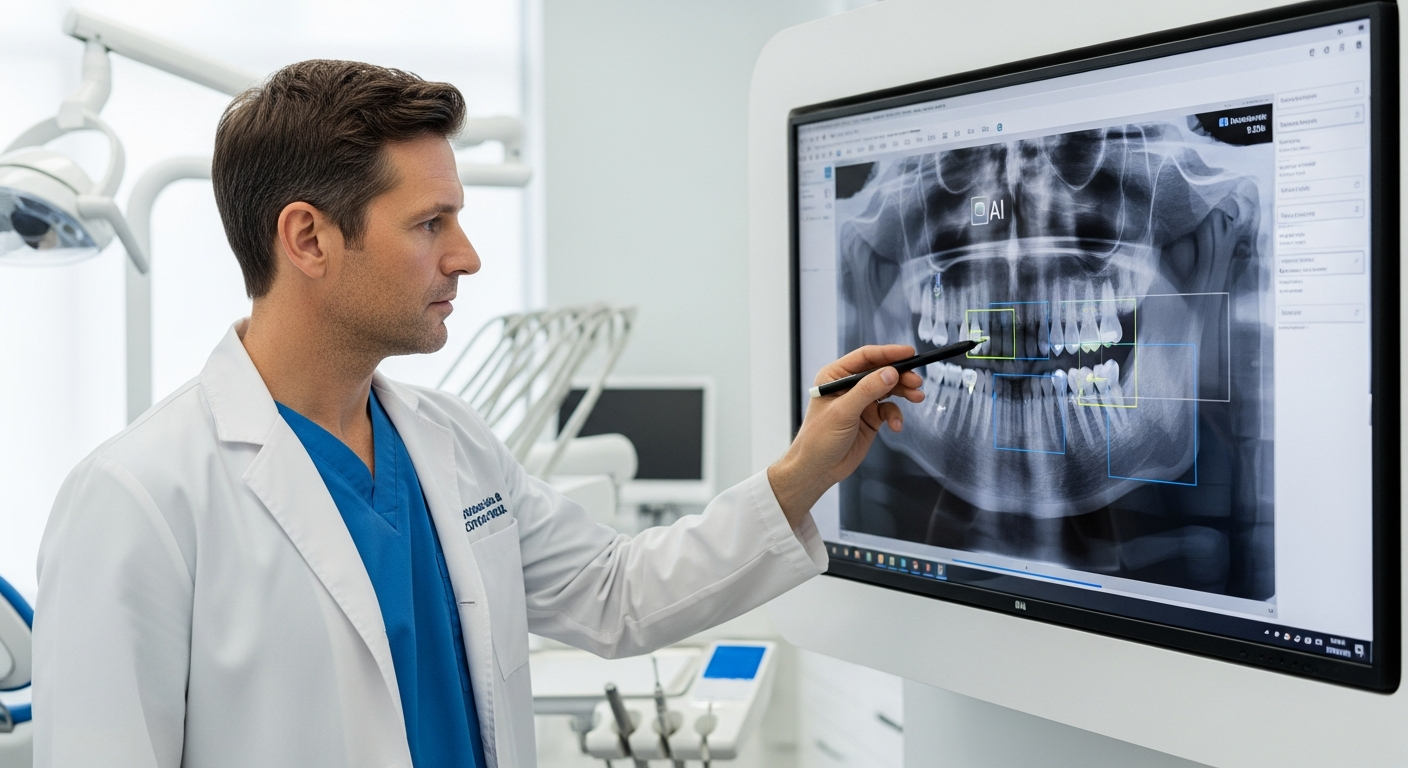
Now look at the consumer end of the funnel. Philips’ AI toothbrush pitch is superficially about tech—sensors, guidance, personalization—but commercially it is an attempt to do something dentistry has historically failed to do at scale: convert oral hygiene from advice into adherence. The two Halloween-candy stories—one in Fox News, another in local radio—are a reminder that acute dental events still drive a huge share of patient attention. But the clinical burden in most practices is not candy-triggered catastrophes; it’s chronic disease progression compounded by inconsistent home care. An AI toothbrush is a wager that the industry can instrument that behavior and close the feedback loop. If a device can credibly improve plaque control, gingival indices, or bleeding scores, it becomes a payer-adjacent narrative and a practice-efficiency narrative at the same time: fewer emergencies from neglect, fewer failed restorative margins due to inflammation, better perio maintenance stability, and more predictable outcomes in aligner therapy and implant maintenance. The technical point is that oral health is a compliance problem disguised as a procedural business. AI brushing is one path to making compliance legible.
That same logic is peeking through the renewed interest in probiotics as adjuncts to periodontal therapy. The systematic review covered by Today’s RDH underscores a clinical reality that often gets oversold in marketing and underappreciated in practice: probiotics are not a monolithic category, and outcomes are strain-, dose-, and protocol-dependent. The best reading of the evidence is cautious, not evangelical. Yet the commercial reason probiotics keep returning to the conversation is that they represent a biologically plausible, relatively low-cost intervention aimed at modulating a chronic condition between visits. Scaling periodontal stability is hard when staffing is tight and recall compliance is imperfect. If adjunctive approaches can modestly reduce bleeding on probing, pocket depths, or inflammatory burden in certain patient segments, they become part of a “maintenance stack” that can be standardized and delegated—provided clinicians do the unglamorous work of selecting products with documented strains and managing expectations. Even when effect sizes are small, the operational value is in repeatability: a protocol the hygienist team can deliver consistently, with measurable checkpoints.
The workforce backdrop makes this more than a theoretical shift. HRSA’s count of dental shortage areas topping 8,000 is a loud signal that access constraints are not a temporary COVID-era artifact; they are structural. In a constrained labor market, any strategy that depends on adding clinician hours is fragile. That is why the industry’s marketing fascination with “one-day” dentistry—from digital implantology segments on Pakistani television to cross-border consultation events advertised by clinics like Maltepe for patients considering treatment abroad—should be interpreted less as a triumph of speed and more as a symptom of scarcity and commoditization. When patients shop internationally for implants or full-arch rehabilitation, they are doing what consumers do in every category when the product feels standardized: arbitrage price and convenience. Digital workflows reduce chair time, yes, but they also reduce differentiation if every clinic is using similar scanners, guided surgery kits, and CAD/CAM protocols. The paradox is that the very technologies that increase efficiency also make the “procedure” easier to compare across providers.
This is where the independent-practice branding column about building a “brand moat” in a DSO-heavy market becomes more than marketing advice; it becomes a clinical strategy. In a world where DSOs can outspend independents on acquisition and where devices are increasingly commoditized, the durable moat is trust anchored in outcomes—especially outcomes that require sustained behavior change. The Dentainment framework—category, promise, proof, repeatable touchpoints—can be read as a prescription for operationalizing evidence-based care. The “promise” cannot be “friendly and affordable,” as the column rightly notes; nor can it be “we have an iTero” when iTero installations are rising across the market and scanner pricing is loosening. The promise has to be something that translates clinically and can be proven: fewer cracked-tooth emergencies through risk-based counseling and occlusal management; better periodontal stability through a defined maintenance protocol; more predictable aligner outcomes through monitored compliance; implant longevity through structured peri-implant maintenance and home-care instrumentation. The proof then becomes data: documented baseline metrics, adherence tracking, and follow-up outcomes—auditable within the practice’s own records and, increasingly, shareable with patients.
The under-discussed tension is that dentistry is trying to industrialize behavior change without admitting that behavior change is the product. Manufacturers are racing to embed themselves in the daily life of patients and the daily workflow of teams. Align’s scanner strategy implies a desire to own the front end of orthodontic decision-making and production routing. Philips’ AI brush implies an ambition to own the daily hygiene ritual. Probiotics and other adjunctive therapeutics imply a push to own the microbial maintenance interval. Meanwhile, the shortage-area data implies fewer clinicians will be available to rescue the system when adherence fails. If you accept that framing, then the competitive battleground is not “who has the best device” but “who can reliably move patient behavior and document the movement.” That is a different kind of moat—built as much on protocols, coaching, and analytics as on capital equipment.
For industry insiders, the “so what” is both uncomfortable and clarifying. If scanner revenue is softening even as installations rise, device companies should expect investors to scrutinize utilization, attach rates, and recurring software margins more than unit shipments; selling boxes will not carry the narrative forever. If AI toothbrushes and similar consumer tech are to matter clinically, they will need validation against outcomes that dentists respect—bleeding reduction, plaque indices, caries incidence in high-risk groups—not just app engagement and “coverage maps.” If probiotics are to earn chairside adoption beyond a niche, they must be packaged as strain-specific, protocol-driven adjuncts with realistic endpoints and clear contraindications, not as lifestyle supplements with dental branding. And if independents want a defensible position against DSOs and against international price arbitrage, they should stop treating marketing as a veneer and start treating it as the public interface of a measurable care system.
The next decade’s winners in dentistry will be the ones who can translate technology into repeatable clinical behavior change under conditions of scarcity. That will require less fetishizing of the newest hardware and more discipline around protocols, data capture, and patient adherence. The scanner, the AI brush, the probiotic adjunct, the digital implant workflow—these are not separate trends. They are pieces of the same strategy: shift value from episodic interventions to managed outcomes. In that world, a practice’s real “brand moat” is not its logo or its Instagram feed; it is the demonstrated ability to keep patients stable between visits, even when the system can’t afford to see them more often.